Client: Lamplite (Josh MacIvor-Andersen), Marquette, MI
Role: Industrial design, pattern engineering, prototype fabrication
Timeline: Four weeks, kickoff to handoff (September–October 2026)
Materials: X-Pac RVX30, titanium, foam, mesh, mil-spec webbing, cord
Deliverables: Sewn prototype, 3-size production pattern set with build order, tiered BOM, ecosystem design document, full process photo/video record
The brief
Josh is a writer building Lamplite, a journal system for people who write outdoors. on the water, on the trail, in weather. He arrived with strong user research, a clear point of view, and one hard requirement: the product had to be designed, not just sewn. It needed to protect a notebook through real expedition use, adapt from a slim softcover to a thick hardcover, and stay honest — repairable, reconfigurable, and recyclable at end of life.
That is exactly the gap I work in. The market splits into fabricators who don’t design and designers who don’t fabricate. This project needed both.
Design first
Before any material was cut, we settled the architecture. The cover separates into five independent functional elements: protection (the chassis), retention (end flaps), containment (a removable belt), support (replaceable book boards), and organization (pockets). Because the parts are independent, the whole cover rotates 180 degrees to switch handedness, the pen slot is centered and opens at both ends, and the closure can be swapped according to personality, e.g. a toe-clip strap for the bikepacker, a Voile strap for the skier, a line for the sailor.
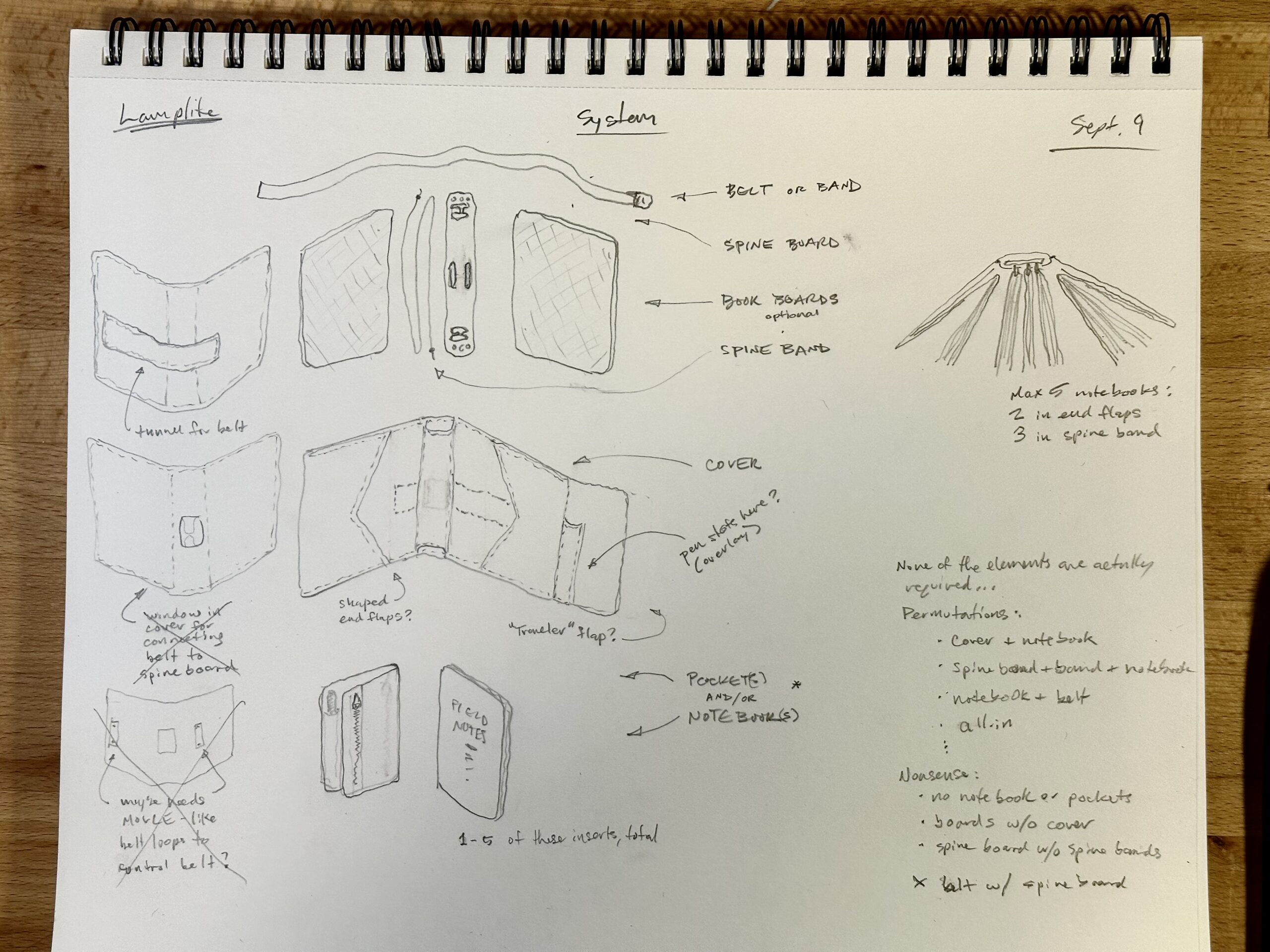
Two decisions are worth calling out because they were head-scratchers:
- The handle lives on the trifold flap’s hinge, not on a fixed spine. A webbing handle would have locked the spine to one notebook width; the hinge mount stays stable in hand and doubles as a shoulder-strap anchor. This preserves the hinge zone, so structure carries the design instead of decoration.
- The book boards are exposed and replaceable. Hidden cheap board inside an expensive cover is a small betrayal; visible, swappable board is honest, and it makes the product repairable—and reconfigurable according to the kind of notebook carried and user preferences.
De-risking before expensive fabric
Composites taught me to test cheap before you cut expensive. Two moves did most of the work:
1. Mockups in IKEA shipping bags. The blue woven polypropylene behaves enough like technical laminate to answer geometry questions like handle position, shoulder-strap load path, or closure ergonomics, and for pennies. Three iterations of mockup ran before the X-Pac was delivered.
2. A two-tier pattern system. One set of durable labeled masters (grain arrows, seam allowances, build notes) generates disposable working copies. The masters stay pristine; the copies get cut, marked, and thrown away. The result is repeatable accuracy without fragile one-use patterns.
Cost as a design tool
The bill of materials was built as a decision instrument, not an afterthought: four material tiers per product, from G10 board with a premium closure at the top to chipboard and generic hardware at the bottom, with fabric yields, bolt-width nesting, and retail targets worked through. The client can move up or down a tier without a redesign. That is what design-led means: the cost structure is a design surface.
Fabrication
The final prototype is sewn in X-Pac RVX30 with a standardized grid-and-grain alignment routine and marking, cut from master-derived patterns against a single source of truth: a digital production pattern document that preserves every detail and doubles as the issue-tracking tool for the next revision.
What the client received
- A sewn prototype in X-Pac RVX30, reviewed in person at the four-week mark
- A production pattern set in three sizes with a build order
- The tiered BOM with yields, costs, and supplier links
- The ecosystem design document and full process photo/video record
- A materials specification sheet, ready for a small production run
Working this way
If you are a small maker with a product idea, or a prototype that needs to grow up, this is the shape of an engagement: drawings first, cheap mockups to kill bad geometry, patterns and cost structure as design tools, then a prototype you can hand to a test user or a factory. One month, one fixed fee, and you own everything.
I take on a small number of design-and-build prototyping engagements per quarter, for outdoor, EDC, and small-batch consumer hardware or softgoods. The first step is a one-hour discovery call, upfront, before any quote.